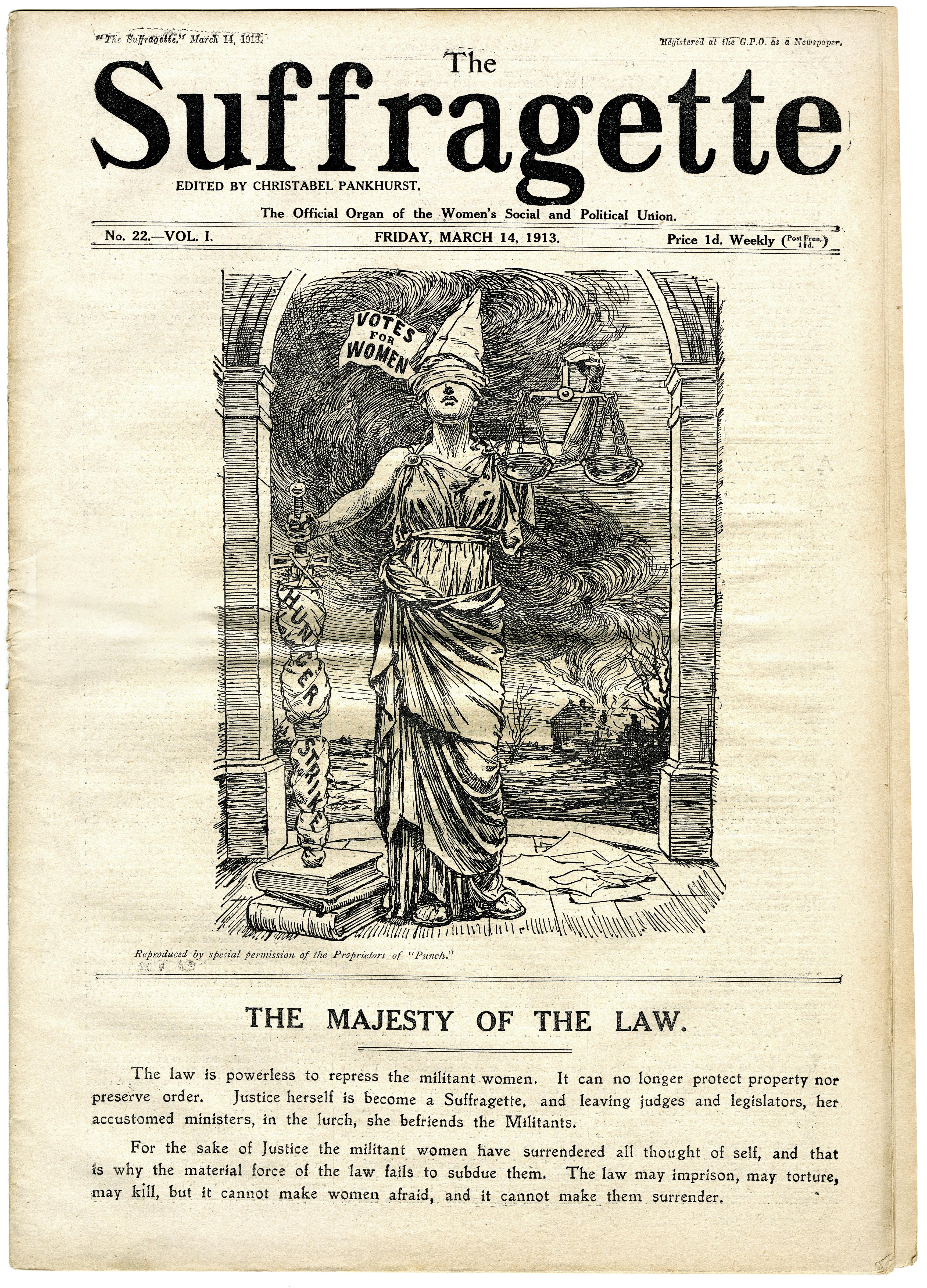
The Suffragette, a periodical that served as the official organ of the Women’s Social and Political Union (WSPU), played a pivotal role in the British suffrage movement during the early 20th century. The issue dated March 14, 1913, emerged within a tumultuous context marked by intensified suffragette activism and the fervent pursuit of women’s voting rights. Edited by the prominent suffragette leader Emmeline Pankhurst, The Suffragette stood as a testament to the strategic use of media to galvanize and mobilize the suffrage cause. In this particular edition, the publication navigated a landscape fraught with political tensions, as suffragettes engaged in a relentless campaign to secure political enfranchisement. The March 14, 1913, issue encapsulates a critical crossroad in the suffrage movement, presenting a snapshot of the suffragettes’ dedication and resilience amidst societal resistance.
The visual on the cover, featuring an image of Justice adorned with a “Votes for Women” banner, operates as a profound and symbolic representation within the context of The Suffragette dated March 14, 1913. The portrayal of Justice aligning herself with the suffragette cause serves as a powerful allegory, challenging established norms and aligning the pursuit of women’s voting rights with a higher moral imperative.
The “Votes for Women” banner, draped across the iconic figure of Justice, carries immense symbolic weight. It transforms the traditionally impartial symbol of Justice into an advocate for suffrage, boldly asserting that the quest for women’s voting rights is not just a legal or political demand but a matter of inherent justice. The banner becomes a visual declaration, merging the scales of justice with the suffragette cause, suggesting that the scales themselves demand balance in the realm of political rights.
The accompanying text amplifies the visual impact by framing the militant actions of suffragette women within a narrative of justice. The assertion that Justice has become a suffragette and is abandoning traditional roles within the legal system underscores the urgency and righteousness of the suffragette cause. The words on the cover proclaim a defiance against the limitations of the law, emphasizing the willingness of suffragettes to endure legal consequences for the sake of a just cause.
This visual and textual synergy shapes a narrative that transcends mere advocacy; it constructs a visual manifesto challenging the very foundations of societal norms. The cover becomes a potent vehicle for the suffragette movement, encapsulating the fervor, sacrifice, and unyielding commitment to justice within the broader struggle for women’s political rights. It is not merely a snapshot of history but a deliberate and strategic piece of visual rhetoric that aims to reshape societal perceptions and assert the suffragette movement as a just and unstoppable force.
National Archives UK. “The Majesty of the Law: The law is powerless to repress the militant women. It can no longer protect property nor preserve order. Justice herself is become a Suffragette, and leaving judges and legislators, her accustomed ministers, in the lurch, she befriends the Militants. For the sake of Justice the militant women have surrendered all thought of self, and that is why the material force of the law fails to subdue them. The law may imprison, may torture, may kill, but it cannot make women afraid, and it cannot make them surrender.” The Suffragette, March 14, 1913.
 ©️ 2023 VOXELLE. All Rights Reserved.
Leave a comment