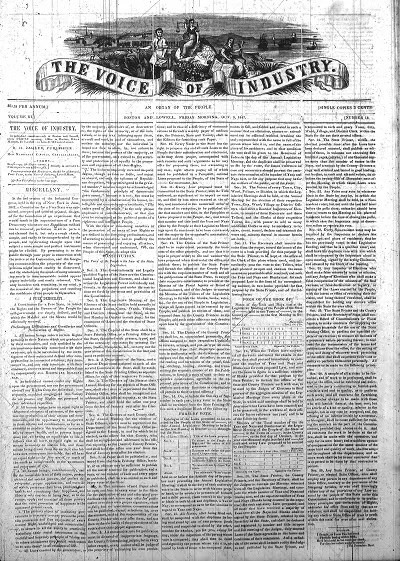
The Voice of Industry, a worker-run newspaper published from 1845 to 1848 amid the zenith of the American Industrial Revolution, stands as a remarkable testament to the dynamic sociopolitical landscape of its time. Founded by William F. Young, a youthful mechanic operating under the auspices of the New England Workingmen’s Association, the paper embarked on a mission primarily focused on land and labor reform. However, its scope expanded far beyond, delving into an array of pressing social issues such as war, education, women’s rights, religion, slavery, and prison reform. Notably, Young championed the inclusion of the “workingmen and women” as the primary authors, emphasizing their adeptness with the pen as comparable to their vocational tools.
Following its establishment, the newspaper relocated to Lowell, Massachusetts, where Sarah Bagley, then president of the Lowell Female Labor Reform Association, became a pivotal figure on the expanded publishing committee. Under Bagley’s influence, the Voice of Industry evolved into the official herald of the Association, assuming a distinctive role in advocating for working women’s concerns. Bagley orchestrated the creation of a regular “Female Department,” exclusively dedicated to “women’s interests,” curated by the self-proclaimed “Factory Girls.” Additionally, the Voice emerged as a significant advocate and organizational force for the Ten-Hour Movement in Lowell, furthering its impact on the labor reform landscape.
The Voice of Industry wielded considerable influence within the broader labor reform movement in the United States. Its distinctiveness lay in being authored and published by the workers themselves, reflecting a deep concern for the transformative social changes accompanying the ascendancy of corporations in economic life. While labor reform remained a focal point, the paper exhibited a comprehensive approach, declaring a commitment to combat “all systems of oppression” and addressing a spectrum of societal matters impacting the community’s well-being. From education to women’s rights, Christianity, slavery, and capital punishment the Voice of Industry embraced a holistic perspective. It not only retained the status of the longest-running labor newspaper during the American Industrial Revolution but also emerged as one of the most widely read among the vibrant array of worker-run journals of that era.
“The Voice of Industry (1845-1848) – Zinn Education Project.” Zinn Education Project, https://www.zinnedproject.org/materials/voice-of-industry-1845-1848/.
“The Voice – Industrial Revolution.” Industrial Revolution, https://www.industrialrevolution.org/the-voice.html. 3: “Voice of Industry | Industrial Revolution.”
 ©️ 2023 VOXELLE. All Rights Reserved.
Leave a comment