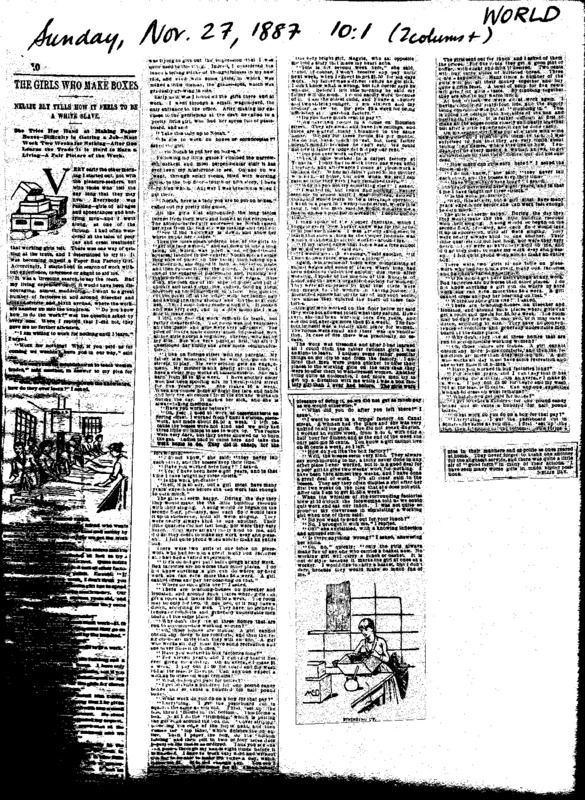
Nellie Bly’s “The Girl Who Makes” series stands as a seminal work within the world of journalism, constituting a groundbreaking exploration into the lives of working women in New York City during the late 19th century. Bly’s articles, characterized by their depth and societal impact, played a pivotal role in instigating conversations surrounding the challenges confronted by women in the workforce, thereby catalyzing a heightened awareness regarding the imperative for enhanced working conditions and equitable remuneration for female laborers.
Within the expanse of her articles, Bly delved into an array of pertinent topics germane to the experiences of working women, intricately scrutinizing the conditions pervasive in factories, sweatshops, and diverse workplaces. Her examinations extended to the manifold challenges encountered by women in securing employment, unraveling the intricacies of their struggles in sustaining both themselves and their families.
A noteworthy exemplification of Bly’s investigative prowess within “The Girl Who Makes” series manifests in her article titled “The Girls Who Make Boxes,” published on November 27, 1887, in the New York World. Herein, Bly delineates the arduous conditions endured by young women employed in a paper box factory, unraveling narratives of prolonged working hours, meager remuneration, and substandard working environments. This expose not only shed light on the harsh realities faced by these women but also advocated fervently for reforms aimed at ameliorating their circumstances. Another illustrative instance is found in her article “The Girls Who Make Shirts,” wherein Bly amplifies the plight of women toiling in a shirt factory. Articulating the challenges encompassing extended working hours, inadequate compensation, and job insecurity, Bly fervently advocates for systemic reforms to enhance the lives of these women.
Nellie Bly’s contributions within “The Girl Who Makes” series reverberate far beyond mere journalistic acclaim; they assume a pivotal role in propelling the labor reform movement within the United States. Widely disseminated and deliberated upon, Bly’s articles not only inspired fellow journalists to cast their pens towards the tribulations of working women but also became integral to the broader labor reform endeavors seeking ameliorated working conditions and wages for all, irrespective of gender. The significance of this series is further underscored by its authorship, as Bly, a woman, played a transformative role in shattering gender barriers within the journalistic domain. In essence, Bly’s indomitable work in “The Girl Who Makes” series not only contributed substantially to the annals of women’s rights and labor reform but also paved the way for subsequent female journalists, etching an indelible mark in the history of the United States.
“Nellie Bly, Girl Reporter.” JSTOR Daily, 14 Nov. 2014, https://daily.jstor.org/nellie-bly-girl-reporter/
“Life Story: Nellie Bly.” Women & the American Story, New-York Historical Society, https://wams.nyhistory.org/modernizing-america/modern-womanhood/nellie-bly/. 3: “The Girl Who Makes.”
The Nellie Bly Collection, Library of Congress, https://www.loc.gov/item/rbcmiller000007/
 ©️ 2023 VOXELLE. All Rights Reserved.
Leave a comment